


“I’m Good at What I Do, So Why Am I Not Getting Customers?”
You know your business is good, but customers still aren’t coming. Here are the most common reasons small businesses struggle to attract customers—and what you can do about it.
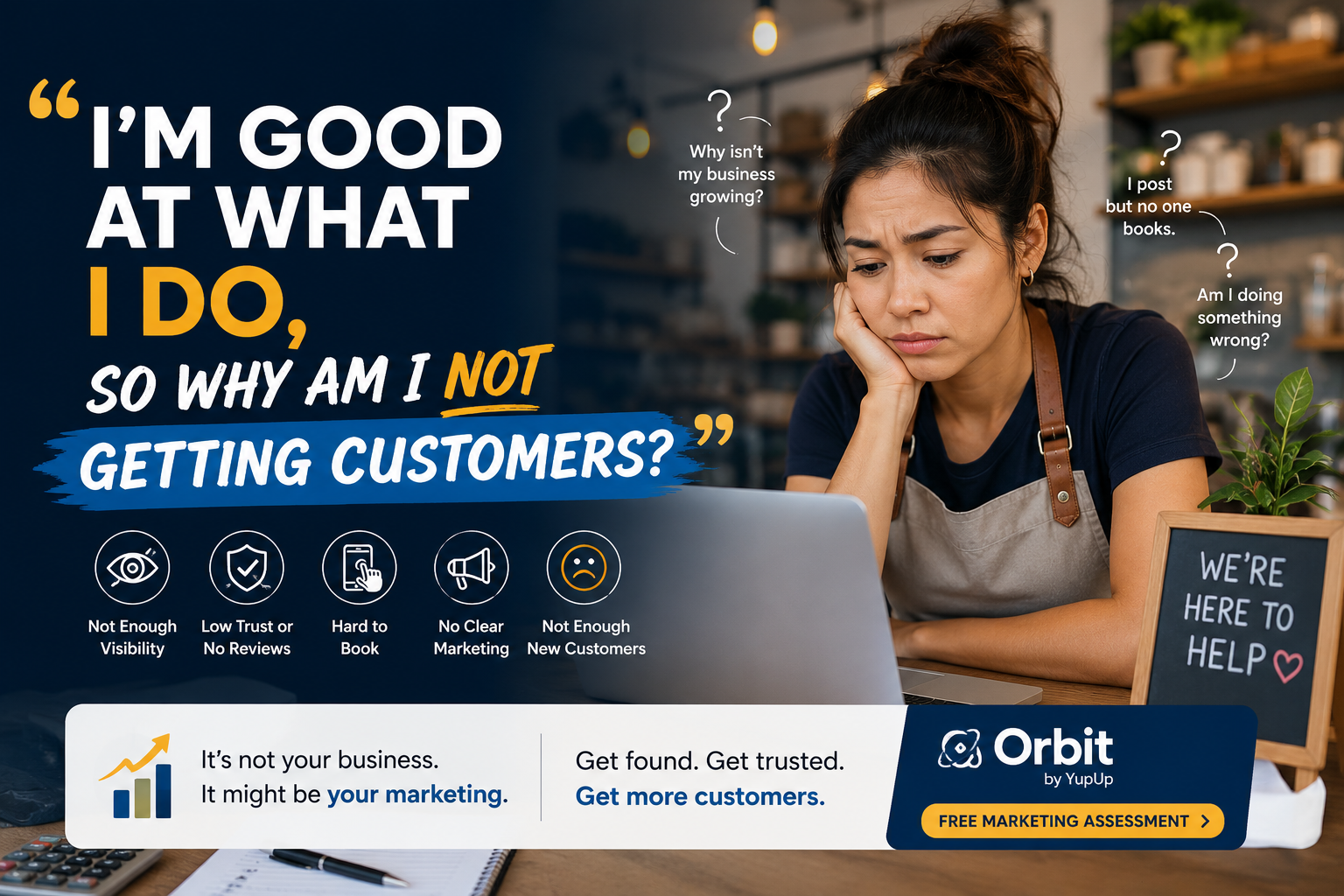
You know you're good at what you do.
Your customers are happy.
You care about the quality of your work.
Maybe people who finally try your business even say:
“I can't believe I didn't know about you sooner.”
And that's exactly the problem.
Being good at what you do doesn't automatically mean people know you exist.
It can be incredibly frustrating to watch another business stay busy when you know your service is just as good—or better.
But the issue usually isn't your talent.
It’s the gap between being good and being discovered, trusted, and chosen.
If your business is struggling to bring in enough customers, here are some of the most common reasons why.
1. Not Enough People Know Your Business Exists
This is the simplest explanation, but it's often overlooked.
You can't become someone's favorite business if they've never heard of you.
Think about how customers discover businesses today.
They might search Google.
They might see something on social media.
They might find a business directory.
They might see a recommendation from a friend.
They might notice a special offer.
They might drive past your location.
Every one of these is another opportunity to be discovered.
If you're relying entirely on word of mouth or occasional Instagram posts, you're asking a very small number of people to do all of your marketing for you.
You need multiple ways for potential customers to find you.
Being great isn't enough if you're invisible.
2. Your Marketing Doesn't Explain Why Someone Should Choose You
Look at how many small businesses describe themselves:
Quality service.
Great customer service.
Affordable prices.
Locally owned.
There's nothing wrong with those things.
But your competitors are saying them too.
A potential customer needs to understand why you are the right choice.
Maybe you're exceptionally fast.
Maybe you specialize in a particular service.
Maybe you work with a specific type of customer.
Maybe you offer flexible appointments.
Maybe you've been serving the community for 20 years.
Maybe your approach is more personal than a large chain.
Maybe you offer something competitors don't.
Your marketing should make that clear.
Instead of:
“We provide professional beauty services.”
Try something closer to:
“Natural-looking permanent makeup designed for busy women who want to spend less time getting ready.”
Suddenly, there's a reason for the right customer to pay attention.
3. Customers Find You, but They Don't Trust You Yet
Imagine you've never heard of your business before.
You search for a service and land on your profile.
What do you see?
No recent photos.
Very few reviews.
An outdated website.
No prices.
No clear description of the services.
No easy way to book.
Would you feel confident handing that business your money?
Probably not.
Customers don't have the advantage of knowing how good you actually are.
They have to judge based on the information available to them.
That's why things like:
- Customer reviews
- Recent photos
- Before-and-after examples
- Testimonials
- Clear service descriptions
- Accurate business information
- Professional-looking profiles
matter.
They're not just decoration.
They're trust signals.
Your job is to make someone who has never met you feel comfortable taking the first step.
4. You're Making It Too Hard to Become a Customer
Sometimes a business successfully gets someone's attention and then loses them right before the finish line.
Imagine this:
A customer sees your business.
They like your work.
They're interested.
They decide they want to book.
Then they have to call during business hours.
Nobody answers.
They leave a voicemail.
You call them back three hours later.
They're busy.
You play phone tag.
Meanwhile, another business lets them book online in 30 seconds.
Who gets the customer?
Probably the other business.
The easier you make it to buy, book, call, message, or visit, the fewer customers you'll lose along the way.
Check your own customer journey.
How many steps does someone have to take before becoming a customer?
Every unnecessary step gives them another chance to leave.
5. You're Posting, but You're Not Really Marketing
This one happens constantly.
You post on Instagram.
Maybe you make a Reel.
You post another photo next week.
Then another.
And somehow...
nothing really changes.
The problem is that posting isn't a marketing strategy by itself.
Good marketing answers questions like:
Who are we trying to reach?
What do they need?
Why should they choose us?
Where can we reach them?
What should they do after seeing our message?
You can post every day and still get very few customers if you're reaching the wrong people or giving them no reason to act.
A picture of today's work might look great.
But something like:
“Three appointment spots left this week. New clients get $20 off their first visit.”
gives someone a reason to do something.
Marketing needs a destination.
6. You're Waiting for Customers Instead of Giving Them a Reason to Act
People procrastinate.
Even interested customers think:
“I'll check it out later.”
Later becomes next week.
Next week becomes never.
That's where a good offer can help.
It doesn't have to mean constantly discounting your services.
You could offer:
- A first-time customer special
- A free consultation
- A complimentary add-on
- A package
- A referral benefit
- A seasonal promotion
- A limited-time deal
The important part is creating a reason to move from:
“Maybe someday.”
to:
“I'll try them now.”
Urgency can turn interest into action.
7. You're Only Talking to New Customers
Businesses spend so much energy trying to find new people that they sometimes forget the customers they've already earned.
Someone who has already paid you is much easier to reach than a stranger who has never heard of you.
Think about your past customers.
How many haven't returned simply because nobody reminded them?
A salon can remind someone it's time for another appointment.
An auto shop can reconnect when maintenance is due.
A restaurant can promote a new menu item.
A cleaning business can offer recurring service.
A dentist can remind patients about their next visit.
Stay connected.
A customer shouldn't have to rediscover your business every time they need you.
8. People Don't Immediately Understand What You Do
This sounds obvious.
But look at your Instagram bio, website, Google listing, or business page.
Could someone understand what you offer in five seconds?
Or would they have to investigate?
Business owners often know their business so well that they accidentally make their messaging complicated.
Customers want simple answers:
What do you do?
Is it for me?
Where are you?
How much does it cost?
How do I get started?
Make those answers easy to find.
Confused customers rarely become paying customers.
9. Your Marketing Keeps Getting Pushed to Tomorrow
This may be the biggest problem of all.
You know you should market your business.
But then:
A customer calls.
An employee needs something.
Inventory arrives.
Someone cancels.
A vendor emails.
Payroll is due.
The day ends.
Marketing gets pushed to tomorrow.
Then tomorrow becomes next week.
This isn't because you're lazy.
You're running a business.
Marketing is competing with everything else that demands your attention immediately.
And that's exactly why many small businesses struggle with consistency.
Good marketing doesn't happen once.
People need to repeatedly see and hear about your business before they remember it.
If marketing only happens when you have spare time, it will almost always be inconsistent.
10. Being Good at Your Business and Marketing Your Business Are Two Different Skills
This is the part small-business owners need to hear more often.
A great hairstylist doesn't automatically know SEO.
A talented chef doesn't automatically understand digital advertising.
A fantastic mechanic doesn't necessarily want to create social media content.
A dentist shouldn't have to become a marketing strategist just to fill appointments.
Being good at your business is one job.
Making sure people discover your business is another.
You can learn marketing yourself.
You can hire someone.
You can use tools that make it easier.
You can automate parts of it.
What's important is recognizing that marketing deserves its own system.
Because waiting for people to magically discover how good you are isn't a growth strategy.
So, Is Your Business Actually the Problem?
Maybe.
Sometimes a business does need to improve its pricing, service, customer experience, or product.
But if your existing customers are happy...
If they recommend you...
If they come back...
If people regularly tell you how much they love what you do...
then your biggest problem might not be your business at all.
It might simply be that not enough of the right people know about it.
And that's a much more fixable problem.
You don't necessarily need to reinvent your business.
You may just need to become easier to:
Find.
Understand.
Trust.
Book.
Remember.
Do those five things better, and being good at what you do finally has a chance to work in your favor.
You're Already Running the Business. You Don't Have to Run the Marketing Too.
Orbit by YupUp helps small-business owners take care of the marketing side of the business—so you can spend more time doing the thing you're actually good at.
YupUp members can also list their business, post deals, and accept customer bookings for free.
Get a free marketing assessment to see what may be stopping more customers from finding and choosing your business.
Need a review and local marketing system?
YupUp helps independent businesses manage reviews, local visibility, and customer follow-up with AI-assisted workflows.
Get a free growth review


