


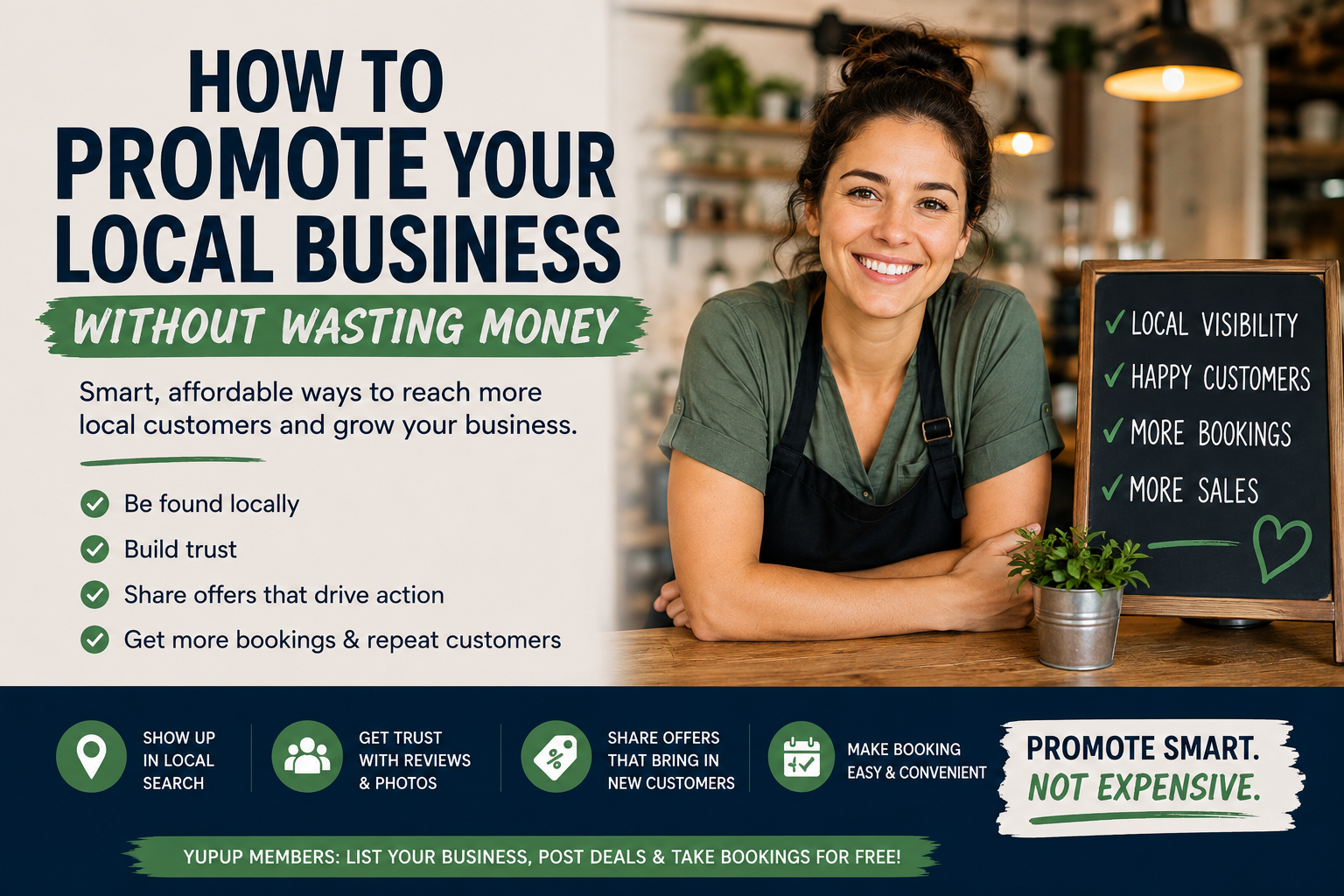
How to Promote Your Local Business Without Wasting Money
Learn practical, affordable ways to promote your local business, reach more customers, and avoid spending money on marketing that doesn’t bring results.
Marketing can feel expensive very quickly.
A boosted post here.
A flyer there.
Maybe you try Google Ads.
Maybe someone convinces you to pay for a directory listing.
Maybe you spend hundreds of dollars on social media content.
And after all of that, you still have the same question:
Did any of this actually bring me customers?
For small businesses, the goal should not be to do more marketing.
It should be to do more of the marketing that actually works.
You don't need to be everywhere.
You need to be in the right places, with the right message, and make it easy for interested customers to take action.
Here are some practical ways to promote your local business without wasting your budget.
1. Start With the People Closest to Buying
A common marketing mistake is trying to reach as many people as possible.
More people does not automatically mean more customers.
If you own a nail salon in Fremont, you probably don't need thousands of people across the country seeing your posts.
You need people nearby who are actually interested in getting their nails done.
The same applies to restaurants, dentists, auto shops, tutors, cleaners, salons, gyms, and most other local businesses.
Before spending money, define:
- Who your ideal customer is
- Where they live or work
- What they are looking for
- What problem you solve for them
- What would make them choose you
A smaller group of the right people is usually more valuable than a huge audience that will never buy from you.
2. Make Sure Your Free Online Presence Is Working First
Before spending money on advertising, make sure your free online presence is complete.
Customers searching for a local business should be able to quickly find:
- Your business name
- Address
- Phone number
- Hours
- Services
- Photos
- Reviews
- Website
- Booking link
- Current promotions
Your Google Business Profile should be accurate and active.
Your business should also appear on relevant local directories and platforms where people are already searching for businesses like yours.
If these basics are incomplete, paid advertising may simply send more people to a profile that doesn't convince them to choose you.
Fix the foundation first.
3. Focus on One or Two Marketing Channels
Small-business owners often feel like they need to do everything.
Instagram.
TikTok.
Facebook.
Google.
Email.
SEO.
Paid ads.
YouTube.
Flyers.
Events.
That's a lot.
And trying to manage everything usually means doing all of it inconsistently.
Instead, choose the channels where your customers are most likely to find you.
For example:
A beauty business may benefit heavily from Instagram, Google, and local search.
A home-service business may get more value from Google, reviews, and referrals.
A restaurant may benefit from local directories, social media, deals, and strong photos.
A B2B service may rely more on Google search, LinkedIn, networking, and email.
You can always expand later.
Start with what has the best chance of bringing in actual customers.
4. Stop Posting Just to Stay Active
Many businesses spend hours creating social media content because they feel like they are supposed to.
But activity is not the same as effectiveness.
Before posting something, ask:
What do I want someone to do after seeing this?
Maybe you want them to:
- Book an appointment
- Visit your store
- Claim an offer
- Call you
- Request a quote
- Try a new service
- Join your email list
Give every marketing message a purpose.
Instead of:
“Happy Tuesday! Here's today's work.”
Try:
“Need a last-minute appointment this week? We have two spots available Thursday. Book now.”
The second post gives someone a reason to act.
5. Use Offers Strategically
Discounts can be powerful, but they can also waste money if they're used carelessly.
The goal is not to train customers to only buy when something is discounted.
Use promotions for specific reasons.
For example:
To attract first-time customers
$20 off your first appointment.
To fill slower times
15% off appointments Tuesday through Thursday.
To introduce a new service
Try our new service this month and receive a complimentary add-on.
To encourage larger purchases
Book two services together and save.
To encourage referrals
Refer a friend and both receive a benefit.
A promotion should solve a business problem—not just reduce the price.
6. Promote Your Deals Where New Customers Can Find Them
Creating a good deal is only half the job.
People need to see it.
Businesses sometimes post a promotion once on Instagram and then wonder why nobody used it.
Your existing followers may see it.
But what about people who don't know your business yet?
Put your offers in places where customers are already searching for local businesses.
That can include:
- Your website
- Your Google profile
- Local business platforms
- Your social media
- Your email list
- Your physical location
Make the offer clear.
Include:
What is the deal?
Who is eligible?
When does it expire?
How do they claim it?
The easier it is to understand, the better.
7. Make Your Existing Customers Part of Your Marketing
One of your best marketing assets is someone who already likes your business.
Happy customers can help you reach new ones through:
- Reviews
- Referrals
- Testimonials
- Social media tags
- Before-and-after photos
- Word of mouth
Don't assume they'll automatically do this.
Ask.
A simple request after a positive experience can make a difference.
For example:
“We're a local business, and reviews really help new customers find us. If you enjoyed your experience, we'd really appreciate one.”
That costs almost nothing.
And a strong collection of genuine customer reviews can make your other marketing much more effective.
8. Build Local Partnerships
You don't always need to pay to reach a new audience.
Sometimes another local business already has the exact customers you're trying to reach.
Look for complementary businesses.
A hair salon could partner with a makeup artist.
A gym could partner with a healthy café.
A real estate agent could partner with a moving company.
A property manager could partner with cleaners, landscapers, and repair businesses.
A wedding photographer could partner with florists, venues, and bridal shops.
You can:
- Cross-promote each other
- Create bundled offers
- Refer customers
- Run a giveaway
- Host a small event
- Feature each other on social media
Good local partnerships can introduce your business to highly relevant customers without a large advertising budget.
9. Don't Pay for Ads Until You Know What Happens After the Click
Paid advertising can work.
But advertising doesn't fix a bad customer journey.
Before spending money, imagine someone clicks your ad.
What happens next?
Do they immediately understand what you offer?
Can they see prices?
Can they trust you?
Can they easily book?
Is the page mobile-friendly?
Is there one obvious next step?
If you spend $500 getting people to visit a confusing page, you may simply waste $500 faster.
Advertising should amplify something that already works.
It shouldn't be used to hide problems with your website, offer, or booking process.
10. Track Where Customers Actually Come From
If you don't track results, it's almost impossible to know what you're wasting money on.
You don't need expensive software to start.
Simply ask every new customer:
“How did you hear about us?”
Track the answers.
After a month or two, patterns will start appearing.
Maybe Google is bringing your best customers.
Maybe referrals are much stronger than Instagram.
Maybe a specific deal works incredibly well.
Maybe nobody has ever mentioned the newspaper ad you've been paying for.
That information is valuable.
Marketing becomes much easier when you know what deserves more money—and what deserves none.
11. Don't Confuse Likes With Customers
A post with 10,000 views can feel exciting.
But if nobody books, visits, calls, or buys, those views aren't helping your business very much.
The same applies to followers.
Having 20,000 followers doesn't automatically mean you have a healthy business.
For most local businesses, the more important numbers are:
- Calls
- Bookings
- Store visits
- Leads
- Purchases
- Returning customers
- Revenue
Marketing metrics can help you understand what's happening.
But don't lose sight of the outcome you actually want.
Customers.
12. Spend More Only After Something Works
This is one of the safest ways for a small business to approach marketing.
Start small.
Test.
Measure.
Then scale.
If a $50 promotion brings in several profitable new customers, try $100.
If a particular offer consistently fills appointments, run it again.
If customers keep finding you through one platform, improve your presence there.
If something isn't producing results, don't keep paying for it just because you've already invested money.
The goal isn't to prove a marketing idea was right.
The goal is to grow your business.
Your Marketing Doesn't Have to Be Expensive. It Has to Be Intentional.
There is no single marketing strategy that works for every business.
But most wasted marketing comes from the same problem:
Businesses spend money before they understand:
Who they're trying to reach.
What message will make that person care.
Where that person is looking.
What happens after they find the business.
Get those things right first.
Then every dollar you spend has a much better chance of doing its job.
You don't need to be the business with the biggest marketing budget.
You need to be the business that makes it easy for the right customer to discover you, trust you, and choose you.
Want to Know Where Your Marketing Budget Is Going?
Orbit by YupUp helps small businesses market themselves without requiring owners to manage everything on their own.
YupUp members can also list their business, post deals, and accept customer bookings for free.
Get a free marketing assessment and find out where your business could be getting more customers without simply spending more money.
Need a review and local marketing system?
YupUp helps independent businesses manage reviews, local visibility, and customer follow-up with AI-assisted workflows.
Get a free growth review


