


Is a Brushless Car Wash Safe for a Tesla? Paint, Chemicals, Pressure, and Cybertruck Explained
Is a brushless car wash safe for a Tesla? Learn how touchless washes clean without brushes, what chemicals and water pressure mean for painted models, and why Cybertruck needs a different approach.
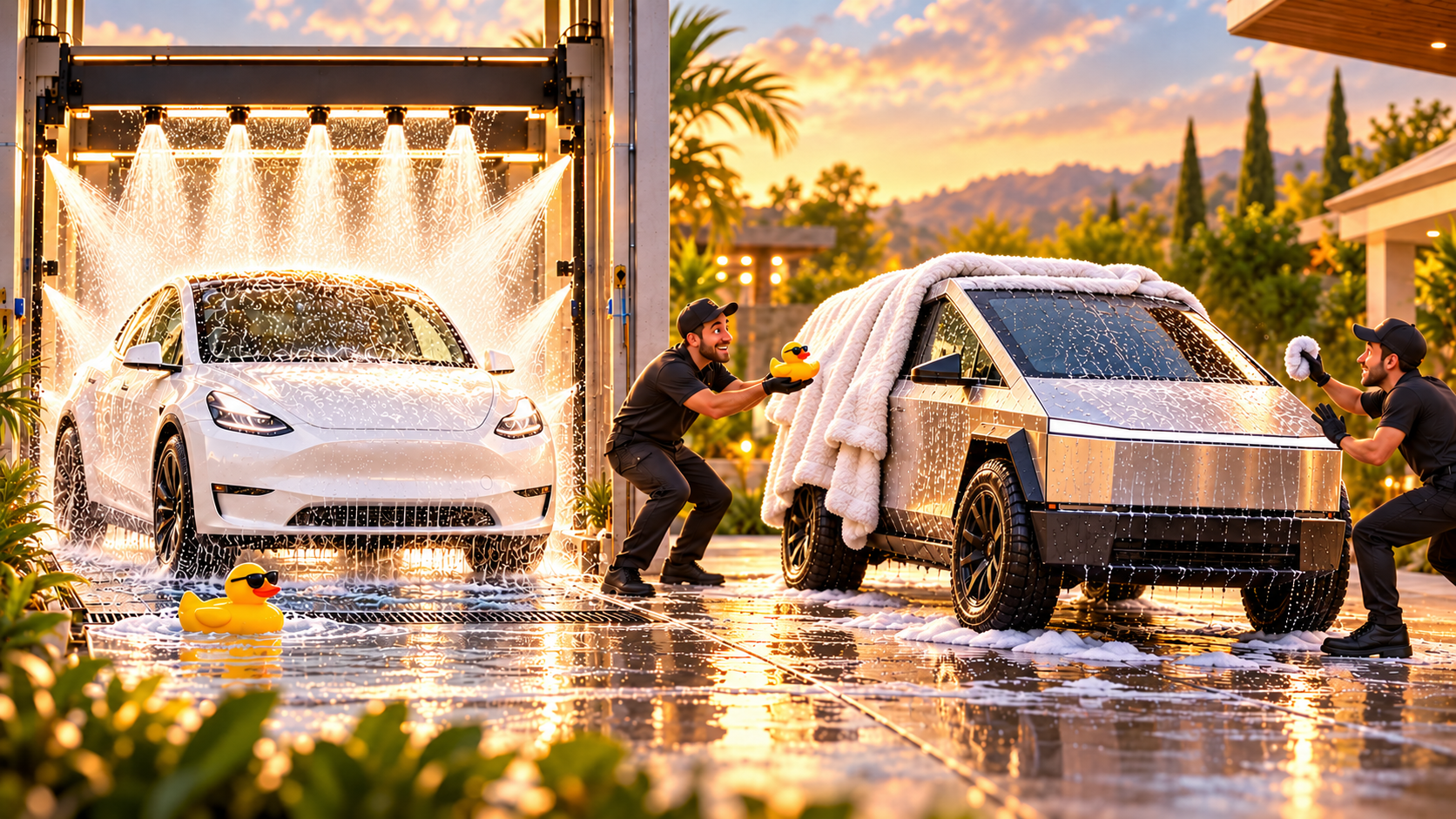
Is a Brushless Car Wash Safe for a Tesla? Paint, Chemicals, Pressure, and Cybertruck Explained
A Tesla owner looking for a car wash will often see three terms: brushless, touchless, and hand wash. They sound similar, but they describe different ways of cleaning a vehicle. The difference is more than marketing. It affects what touches the exterior, how dirt is removed, and which risks a driver should consider.
For a painted Tesla such as a Model 3 or Model Y, Tesla says to use a touchless wash if choosing an automatic car wash. It also gives instructions for washing the vehicle by hand. Cybertruck needs its own discussion: its stainless steel body panels have no clear coat, and Tesla does not recommend taking it through an automatic wash.
Here is how to make sense of those instructions before you choose a wash.
First, what does “brushless” actually mean?
A touchless automatic wash sprays cleaning products and water onto the car without brushes or cloth equipment moving across its body. A hand wash has no machine brushes, but a person’s washing materials still make contact with the surface.
That makes touchless the more precise term when you want to know whether an automatic wash will touch the vehicle. If a business advertises a “brushless wash,” ask whether it means a touchless machine, a hand wash, or both.
An automatic brush or cloth wash is different again: its cleaning equipment physically moves against the exterior. Tesla’s Model Y cleaning instructions say that an automatic wash should be touchless. Its Model 3 manual gives the same direction. Always check the manual for your particular model and year.
Why does contact matter to paint?
On a painted vehicle, the visible finish is more than a single layer of color. Automotive paint systems can include a color coat and a clear coat over it. The clear coat contributes to the finished appearance, but it can still be marked. Tesla’s body repair instructions discuss repairing the base color coat and applying clear coat to a full panel.
A common concern during washing is abrasion: if dirt or grit remains between a washing material and the surface, moving that material can leave fine marks. That is why a careful hand-wash process starts by rinsing loose contamination away and uses clean, suitable materials rather than rubbing a dirty panel.
A touchless wash avoids that particular source of contact. It does not make the car immune to damage, and it will not necessarily remove every stubborn mark. Those are separate questions: How much contact is there? and How effectively does the wash remove the dirt?
You may hear that “Tesla paint is thin” or that one Tesla color is always harder to care for than another. Neither is a sound rule for every vehicle. Tesla offers different colors and finishes across models and years, and a vehicle may also have been repaired, wrapped, or covered with paint protection film. Judge the wash process against the actual finish on your car.
How does a touchless wash remove dirt without scrubbing?
A touchless wash relies on a sequence of cleaner, dwell time, rinse, and dry.
The cleaner wets the surface and helps loosen contamination. Surfactants in wash products help water spread and carry away some oily road film. Certain commercial pre-wash products also use alkaline chemistry to tackle stubborn grime. The product stays on the car for a specified time; water then rinses away the loosened material.
This is the trade-off behind touchless washing. Without physical scrubbing, the wash may need effective chemistry and carefully directed water. A fast touchless cycle can remove ordinary surface dirt yet leave some bonded road film, bug residue, or heavy grime behind. Repeating a harsh chemical cycle is not automatically the right answer for a stubborn spot; a careful hand wash or detail may be more appropriate.
“Touchless” describes the equipment, not the chemical formula. Two touchless washes may use different products, concentrations, rinse processes, and drying methods. Even if a wash describes its foam as “pH-balanced,” that phrase alone does not establish the pH of every product as it reaches your car. The operator would need to identify the actual product and how it is mixed.
What does Tesla say about wash chemicals?
Tesla’s Model Y manual recommends mild, high-quality car shampoo when washing by hand. It cautions against hot water, highly alkaline or caustic cleaners, certain solvents, and exposure to soaps or chemicals above pH 13. It also warns against chemical-based wheel cleaners or pre-wash products that can damage wheel finishes.
The pH 13 warning needs context. It is not a suggestion that a cleaner at or just below pH 13 is ideal for routine Tesla washing. Product ingredients, concentration, exposure time, the surfaces being cleaned, and thorough rinsing all matter. A product’s pH in its container may also differ from its pH after dilution for use.
If you have a wrap, ceramic coating, paint protection film, aftermarket wheels, or a repaired panel, tell the wash operator. Follow the care instructions for those materials as well as Tesla’s vehicle guidance. A car can have several different exterior surfaces, and one cleaner may not be suitable for all of them.
Can water pressure be a problem?
Yes. Touchless does not mean the water is gentle everywhere it lands. Tesla says that when pressure washing a Model Y, the nozzle should remain at least 12 inches (30 cm) from the vehicle, keep moving, and avoid a concentrated jet on one area. Tesla also cautions against aiming water directly at seals, electronic components, exposed cabling, and parking sensors where fitted.
The charge port deserves particular care. Tesla warns against directing a high-velocity spray toward it while the vehicle is charging. Before any wash, close the charge port and follow your vehicle’s Car Wash Mode instructions.
A wash operator should be able to explain how its equipment works. For a modified vehicle, one with loose trim, or one with film edges that may be lifting, ask about the wash before entering rather than relying on the word “touchless” alone.
What does Car Wash Mode do?
Car Wash Mode prepares vehicle features for washing; it does not turn every type of wash into an appropriate one.
For example, Tesla says Model Y Car Wash Mode closes the windows, locks the charge port, and disables the windshield wipers and certain other functions. The vehicle must be stationary and not actively charging when the mode is enabled. Tesla gives separate Free Roll instructions for an automatic wash that moves the vehicle on a conveyor. A stationary wash may operate differently.
Read the instructions shown for your model and software version, and ask an attendant what the wash requires before driving in. Tesla notes that car-wash damage is not covered by its warranty simply because Car Wash Mode was used.
Is a hand wash safer than touchless?
There is no universal winner for every dirty vehicle. A careful hand wash gives a person the chance to work on wheels, lower panels, bug residue, and other areas that a quick automatic cycle might miss. It also introduces contact, so the materials and technique matter.
Tesla’s Model Y instructions call for rinsing away grime and grit first, then washing with a clean, soft material and mild car shampoo. They caution against rough or tight-napped cloths. Drying matters too: dragging a contaminated drying towel over the car can create the contact you were trying to avoid during washing.
For light dust, a touchless wash may offer a convenient clean with less contact. For stubborn contamination, a well-executed hand wash may deliver a more complete result. Ask what the service includes instead of choosing solely by its name.
What if the Tesla has paint protection film or a wrap?
Film adds another surface with its own care requirements. The maker of your film should be the first source for its washing instructions. For example, 3M advises choosing a touchless wash if a film-covered vehicle must use a car wash. It warns that brushes can scratch or dull film and lift an edge. Aggressive pressure washing can also force water under film and weaken its bond.
That means “touchless” still requires care around film seams and edges. If you notice an edge lifting, ask the film installer how to address it before directing a strong spray at that area. Do not assume that instructions for one manufacturer’s film apply to every wrap or coating.
Why is Cybertruck different?
Cybertruck’s visible stainless steel body panels do not have a clear coat. Tesla explains that scratches on those panels are in the steel itself, rather than in a clear layer above it. The company’s Cybertruck exterior cleaning instructions call for flushing away grit, washing with a mild, pH-neutral soap, rinsing, and drying with clean microfiber.
Tesla warns against acidic, highly alkaline, and caustic products on the Cybertruck exterior. It also says to remove contamination such as bird droppings, tree resin, bugs, and road salt promptly rather than waiting for the next complete wash. Cleaners can affect other parts of the truck too, including plastic trim, lights, and camera lenses.
Tesla does not recommend taking Cybertruck through an automatic car wash. The manual includes Car Wash Mode instructions for a situation where an automatic wash is necessary, but having that mode does not make an automatic wash Tesla’s preferred cleaning method.
A Cybertruck owner should discuss a hand-wash process and the specific products used before service. If the truck is wrapped, the wrap’s care instructions add another set of requirements. Vehicle size and clearance should also be checked before entering any wash bay.
How should you choose a wash?
Start with the process, not a slogan. Ask:
- Is the automatic wash truly touchless, with no equipment contacting the body?
- Which products are applied to paint, wheels, and trim, and are they suitable for your vehicle’s finish?
- Is the vehicle rinsed thoroughly so cleaner does not dry on its surfaces?
- If choosing a hand wash, how are loose grit and dirty washing materials handled?
- Can the wash accommodate your vehicle and its accessories, film, or wrap?
For Tesla drivers in the Sacramento area, Bubble Bee Car Wash lists both touchless express and hand wash options at 6225 Binet Drive, Citrus Heights, CA 95621. Its listed hours are 9 AM–6 PM, seven days a week. Call (916) 500-2866 to discuss your specific vehicle and service before visiting, especially if you drive a Cybertruck or have an unusual finish or accessory.
The short answer
For a painted Model 3 or Model Y using an automatic wash, Tesla says to choose touchless. A careful hand wash is another option described in its manuals. Touchless cleaning avoids machine contact, but chemistry, pressure, rinsing, and the vehicle’s finish still matter. Cybertruck needs separate care: Tesla recommends a mild, pH-neutral hand-washing process and does not recommend an automatic car wash.
References: Tesla Model Y cleaning instructions · Tesla owner’s manuals by model · Tesla Cybertruck exterior cleaning instructions · 3M auto film care
Featured business
Need a review and local marketing system?
YupUp helps independent businesses manage reviews, local visibility, and customer follow-up with AI-assisted workflows.
Get a free growth review